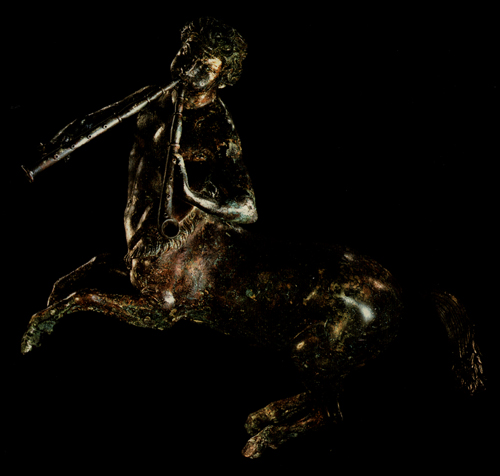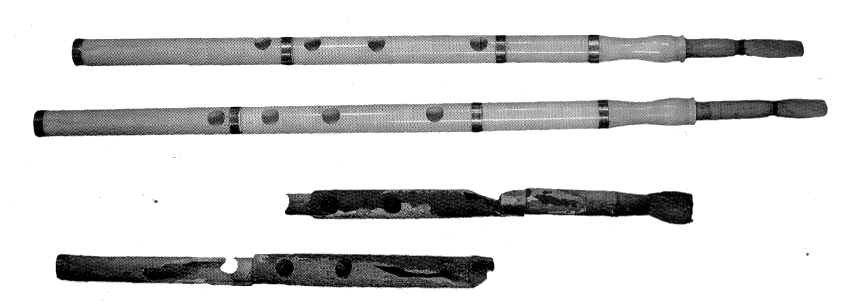
Picture: private collection
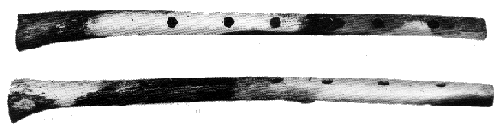
Picture: Museum Valkhof Nijmegen
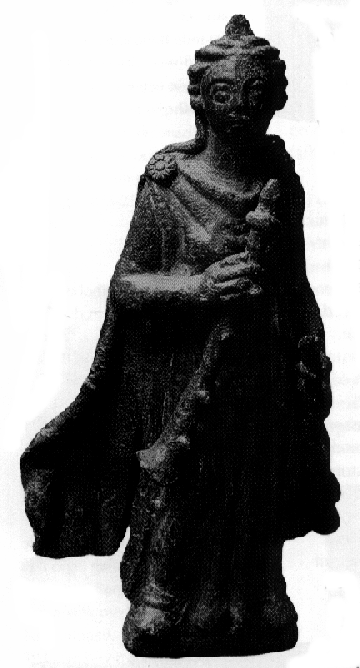 The Greek Aulos and his Roman equivalent Tibia consisted out of two wind instruments.
The musician held one in both hands. The instrument has a lot in common with the clarinet
because in the evolution of this instruments it also gets lids. It was made out of
reed, bone, ivor or (for the pro) metal. The main problem was the the weight could not be
high, because one had to use two of it. The tuning was strict. If the player wanted to
play in another tune, he had to take another aulos or use an extension. Pronomos from Thebe
invented another system. He graved more holes into the tube which he could close with
strips. Later on these became lids like on the clarinet.
The Greek Aulos and his Roman equivalent Tibia consisted out of two wind instruments.
The musician held one in both hands. The instrument has a lot in common with the clarinet
because in the evolution of this instruments it also gets lids. It was made out of
reed, bone, ivor or (for the pro) metal. The main problem was the the weight could not be
high, because one had to use two of it. The tuning was strict. If the player wanted to
play in another tune, he had to take another aulos or use an extension. Pronomos from Thebe
invented another system. He graved more holes into the tube which he could close with
strips. Later on these became lids like on the clarinet.
Picture: private collection
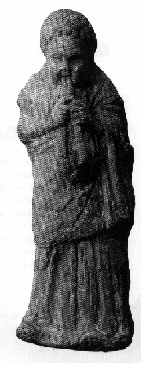 Why in the world did they play on two flutes at the same time ? Because, assuming that
the Greek did not know unison music, two melodies at the same were not interesting.
One assumes now that on the one flute, the basictone was played, on the other one
the melody. But this conflicts with the images: the position of the hands are always the
same. The explanation then can be found if we compare both flutes. The holes of both flutes
were not at the same hight. The differences were so little that you could not make a hole
on 1 tube. Conclusion: the player could chose, while playing his melodie, which note
to take. This is because the Greek used quarter tones, and so on.. which lie very close
to eachother and not so audible for a not-trained ear, but for a musicians, it DOES make
a difference !
Why in the world did they play on two flutes at the same time ? Because, assuming that
the Greek did not know unison music, two melodies at the same were not interesting.
One assumes now that on the one flute, the basictone was played, on the other one
the melody. But this conflicts with the images: the position of the hands are always the
same. The explanation then can be found if we compare both flutes. The holes of both flutes
were not at the same hight. The differences were so little that you could not make a hole
on 1 tube. Conclusion: the player could chose, while playing his melodie, which note
to take. This is because the Greek used quarter tones, and so on.. which lie very close
to eachother and not so audible for a not-trained ear, but for a musicians, it DOES make
a difference !
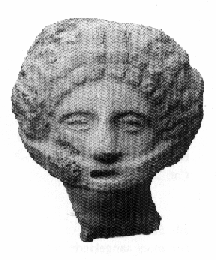 An important accessory for blowing on the auloi is the 'phorbeia'. This is a band around
the head with two holes in it in which the flutes could be attached. They used this band
because when the had to blow hard on it, they couldn't afford to loose their instruments.
This is not so aesthetic, but the consequence was very important. Especially during plays
or in battle, where they had to blow very hard, this was very handy.
An important accessory for blowing on the auloi is the 'phorbeia'. This is a band around
the head with two holes in it in which the flutes could be attached. They used this band
because when the had to blow hard on it, they couldn't afford to loose their instruments.
This is not so aesthetic, but the consequence was very important. Especially during plays
or in battle, where they had to blow very hard, this was very handy.
A variant of the Greek Aulos is the Phrygian Aulos (elymos). In the Roman period, it appeared also a lot. The tubes didn't have the same length and the left tube also looked like a horn. The Romans perfected this instrument by fixing rings and lids on it. It is associated a lot with Dionysios, Rhea and escecially Kybele.