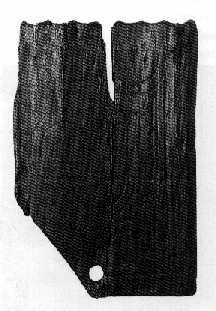
Picture left : Musée Alésia, Alise-Saint-Reine
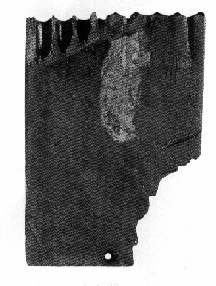
Picture right: Rijksdienst voor Oudheidkundig Bodemonderzoek
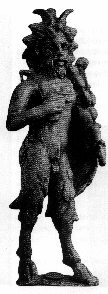 This is without discussion the most famous instrument from antiquity. It is founded already
on the Cyclads around 2500 BC. It dissapeares a little time, but with the growing of
Greek culture it comes back. The origin is connected to a myth. You can read that in the
'Metamorphosis' of Ovidius. Pan, a god born with the paws of a goat, horns and a hairy
upper part of the body badgered on the Olympus. He left this world and established hisself
in Arcadie. He is the god of the forest, the open country and is in general associated
with nature. In the woods, he did only 3 things: play on his flute, pick up girls and
stomp with his feet to scare the people. One day, he fell in love with the waternymph
Syrinx. However, she did not want him and ran away from him. When she reached
the river Ladon, which she couldn't cross, she begged Artemis that she would change here
into something, because, falling in his hands was the last thing she wanted. When Pan held
her, he noticed he was holding reed. He sighed and this caused a magical and comforting
sound out of the holes. To find comfort, he plucked some stalks, bound them togheter and
called it Syrinx. Beautiful isn't it ? :-) Still, in some stories, the pan-pipe is
associated with Hermes (Cf. Homeric Hermes-hymne). But more and more, pan was associated
with it. It became the instruments of the shepherds. Thats why it didn't
get much appreciation by
composers and intelectuals.
This is without discussion the most famous instrument from antiquity. It is founded already
on the Cyclads around 2500 BC. It dissapeares a little time, but with the growing of
Greek culture it comes back. The origin is connected to a myth. You can read that in the
'Metamorphosis' of Ovidius. Pan, a god born with the paws of a goat, horns and a hairy
upper part of the body badgered on the Olympus. He left this world and established hisself
in Arcadie. He is the god of the forest, the open country and is in general associated
with nature. In the woods, he did only 3 things: play on his flute, pick up girls and
stomp with his feet to scare the people. One day, he fell in love with the waternymph
Syrinx. However, she did not want him and ran away from him. When she reached
the river Ladon, which she couldn't cross, she begged Artemis that she would change here
into something, because, falling in his hands was the last thing she wanted. When Pan held
her, he noticed he was holding reed. He sighed and this caused a magical and comforting
sound out of the holes. To find comfort, he plucked some stalks, bound them togheter and
called it Syrinx. Beautiful isn't it ? :-) Still, in some stories, the pan-pipe is
associated with Hermes (Cf. Homeric Hermes-hymne). But more and more, pan was associated
with it. It became the instruments of the shepherds. Thats why it didn't
get much appreciation by
composers and intelectuals.
Picture: Private collections
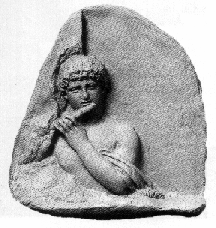
Picture: Allard Pierson Museum Amsterdam